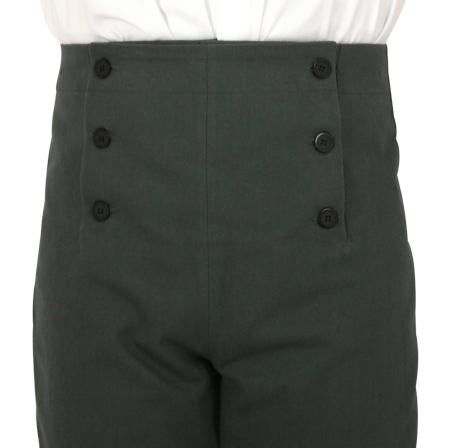
Men's Regency Fall Front Trousers (1800s - 1830s)

Marking the transition from pantaloons and breeches, the Regency trousers introduced a distinctive flap panel or 'fall' in the front. The evolution from broad to narrow falls mirrors the journey to today's button fly, capturing the spirit of the early 1800s.

They became increasingly popular throughout the period, reflecting a shift towards longer, closer-fitting legwear. Paired with tailored coats and waistcoats, fall front trousers were essential for achieving the fashionable Regency gentleman's look, embodying both comfort and refined style.

Explore the variety in our trouser collection and reach out with any queries.

Filter

Filter

6 products

Q&A About Men's Regency Fall Front Trousers (1800s - 1830s)

Men wore fall front trousers primarily during the late 18th century through the 1830's. The button fly front closure, similar to modern pants, became popular in the 1840s. Fall front pants remained popular in formal and military attire until around the 1850s when they began to be replaced by more modern trouser designs.

For Bridgerton events, men should wear fall front trousers or breeches, which are historically accurate for the Regency period portrayed in the show. These high-waisted trousers with the distinctive front flap closure would be paired with a waistcoat, tailcoat, and cravat for an authentic Bridgerton-inspired ensemble.

Men generally stopped wearing fall front trousers by the mid-19th century. Early adopters switched to button fly front pants in the mid-1840s, and the fall front style was gradually replaced by fly-front trousers with the more familiar button closures we see today.

Fall front trousers should not be worn with a belt, as they were designed to be worn with suspenders (braces) attached to buttons inside the waistband. The high-waisted design and traditional construction of fall front trousers make them incompatible with modern belts and belt loops.

The main difference between breeches and fall front trousers is their length: breeches end just below the knee and are often worn with stockings, while fall front trousers extend to the ankle. Both garments feature the distinctive front flap closure, but breeches are typically more fitted and often include knee buckles or ties to secure them around the leg.

To measure for fall front trousers, you need to take waist measurement at your natural waistline (near the navel, not where modern pants sit). The fall front trousers are not designed to sit below the belly in the same way that modern pants and jeans do.

Yes, fall front trousers are high waisted by modern standards, typically sitting at or near the natural waist around the navel area. This higher waistline was standard for men's fashion during the Regency and Victorian periods, creating the distinctive silhouette of the era when paired with tailored coats and waistcoats.

During the Regency era, men wore primarily fall front trousers or breeches as their standard lower garments. The trousers were typically high-waisted, moderately fitted through the leg, and featured the distinctive front flap closure, while breeches ended just below the knee and were worn with stockings for more formal occasions.

In the Pride and Prejudice era (early 19th century), men typically wore tailcoats with high collars, waistcoats (vests), and either knee breeches with stockings or fall front trousers. Their ensembles were completed with cravats, dress shirts with high collars, and dress shoes or boots, representing the fashionable Regency gentleman's attire.

To authentically portray Mr. Darcy from Pride and Prejudice, you should wear a dark tailcoat, light-colored waistcoat, white shirt with high collar, carefully tied cravat, and either fall front trousers or knee breeches with stockings. Complete the look with period-appropriate footwear like Hessian boots or dress shoes, and consider adding accessories like gloves and a top hat for formal scenes.

Historical Emporium's fall front trousers are real clothing and made to be worn many times, not just for one event. While they're often used for historical reenactment, theatrical productions, and period events, they're made to be wearble garments rather than being simplified costume versions.

Fall front trousers close with a distinctive flap (called a "fall") that covers the front of the trousers and typically fastens with buttons on each side of the waistband. This front panel lifts up to allow the wearer to put on or remove the trousers, providing a more formal appearance than later button-fly designs while maintaining the smooth front appearance valued in Regency and early Victorian fashion.

Historical fall front trousers were typically made from wool for everyday and formal wear, cotton for summer and casual styles, and occasionally silk or silk blends for the most formal evening wear. For Regency gentlemen, buff-colored or cream wool, fine black wool, and various patterns including subtle stripes were popular choices depending on the occasion and time of day.

Fall front trousers should fit snugly but comfortably at the natural waist (near the navel), with enough room through the seat and thighs to allow for movement and sitting. Unlike modern slim-fit trousers, historical fall front styles typically featured a straighter cut through the leg rather than being tapered, ending at the ankle or with a slight break over the shoe or boot.

Your Recently Viewed Items