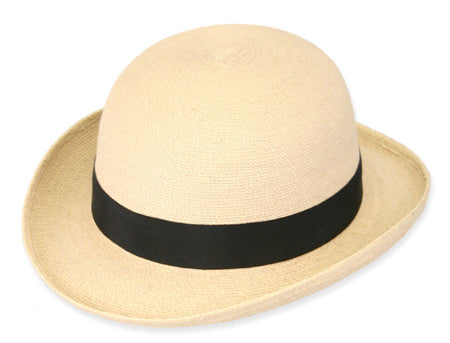
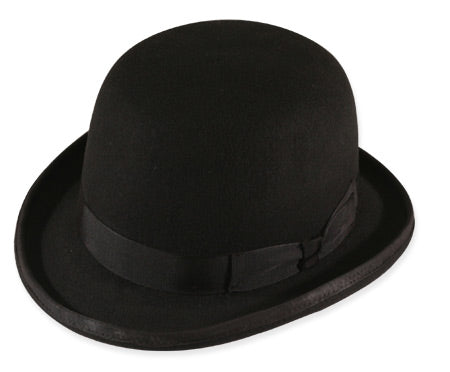
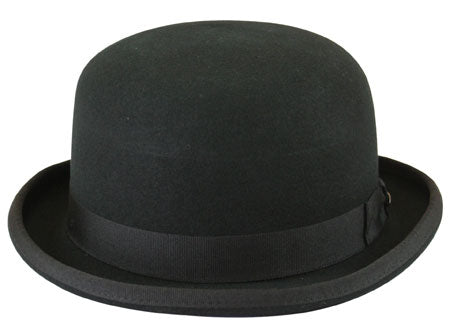
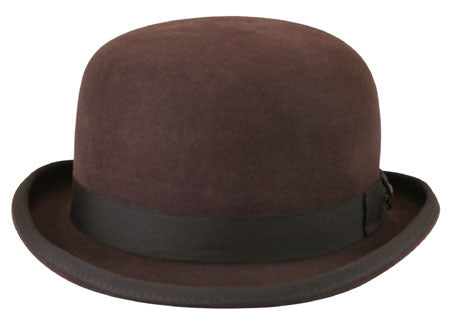
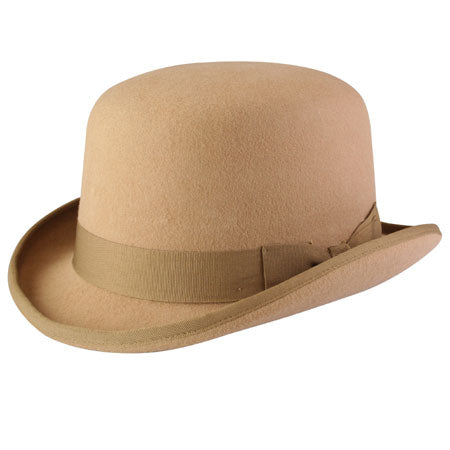
Vintage Derby / Bowler Hats

Americans call it a derby, after the Earl of Derby who helped popularize it. But Englishmen know it as a bowler, as it was first introduced in the early 1850s in England and produced by the Bowler Brothers Company. It crossed the pond to America in the 1860s and remained popular well past the turn of the century.

The Derby is a popular style hat that bridges the gap between casual and formal; a gentleman can feel dressed for the occasion without being gauchely overdone.

We offer a full line of men's period clothing styles which are suitable for movie and TV production, theatrical, living history and performing arts requirements, and are also perfect for vintage weddings. Please contact us if you have any questions!

Vintage Derby / Bowler Hats
Filter

Filter

6 products

Q&A About Vintage Derby / Bowler Hats

Americans call a bowler hat a derby because the style became popular at the Kentucky Derby horse race in the late 19th century. The name "derby" stuck in American vernacular while the British continued to use "bowler," named after its creators, the London hatmakers Thomas and William Bowler.

The difference between a bowler hat and a top hat is in their shape and formality. Bowler hats have a rounded crown and a short brim, while top hats feature a tall, flat-topped cylindrical crown and are considered more formal, typically worn for evening events and formal daytime occasions.

Another name for a derby hat is a bowler hat, which is the British term for this style. In some regions, it may also be called a “coke hat” (the original British term), a “billycock,” or a “bombín” in Spanish-speaking countries.

There is no difference between a derby hat and a bowler hat—they are two different names for the exact same style of hat. “Bowler” is the British term, named after its creators, while “derby” is the American term that became popular through association with the Kentucky Derby.

Famous people who wore bowler hats include Charlie Chaplin (whose "Little Tramp" character made it iconic), Winston Churchill, Stan Laurel and Oliver Hardy, John Steed from "The Avengers" TV series, and Oddjob from the James Bond films. In the business world, they became associated with London bankers and civil servants.

Oval, square, and heart-shaped faces typically suit bowler hats best. The rounded crown and curved brim of a bowler create balance for angular face shapes, while the structured form and defined brim help add definition to softer facial features.

You can wear a bowler hat casually in modern fashion, though historically it was considered semi-formal attire. Today, a bowler can add distinctive character to casual outfits when paired with jeans, a T-shirt or casual button-up, and boots or casual shoes, creating an interesting juxtaposition of formal and informal elements.

The English call a derby hat a bowler hat. The name comes from its creators, London hatmakers Thomas and William Bowler, who designed it in 1849 for Edward Coke, the younger brother of the 2nd Earl of Leicester, as a protective hat for gamekeepers.

A properly fitting bowler hat should sit comfortably about one-half inch above your ears and eyebrows, neither too tight nor too loose. The hat should feel secure but not cause pressure points on your forehead, and when tilted forward slightly, a well-fitted bowler stays in place without sliding down.

To care for a quality bowler hat, use a soft hat brush to remove dust by brushing, handle it by the brim to avoid warping the crown, and store it upside down on its crown or on a hat rack. Protect it from rain and moisture, and if it gets wet, allow it to dry naturally away from direct heat.

In Victorian times, the bowler hat held significant social meaning as a symbol of the rising middle class and professional workers. While top hats were worn by the upper class for formal occasions, the bowler served as practical yet respectable headwear for businessmen, clerks, and shopkeepers, signaling respectability without aristocratic pretension.

A bowler hat complements historical costumes from the late Victorian era (1860s–1900s), Edwardian period (1901–1910s), and early 20th century (1920s–1930s). It pairs especially well with period-appropriate business attire, Western outfits of the American frontier, and steampunk-inspired ensembles.

Your Recently Viewed Items