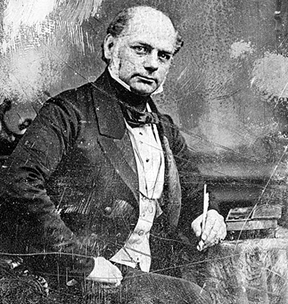
Men's Portrait Gallery 1840

1840’s men's fashion was marked by tightly tailored coats and trousers.  In fact, some wealthy gentlemen continued to wear corsets.  The coats were noticeable for their fitted sleeves and often featured oversized buttons.  Frocks and cutaway coats were the most common style.

Vests were still de rigueur and are seen in both notch and shawl collar variants as well as single and double breasted styles.  Shirts featured a high straight collar, though some did appear with a slight turndown over the cravat.

At the outset of the decade cravats were relatively thin and often worn in the familiar bow tie style.  But by the end of the decade, gentlemen wore very wide cravats, some of which featured frames to hold the fabric in place throughout the day.

This decade also marks the movement from fall front trousers (those featuring a front flap with a button side seam) toward the fly front trouser with which we are all familiar.
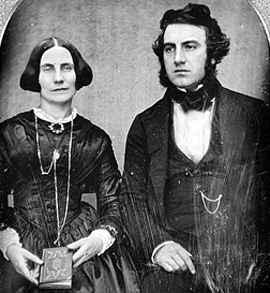
The Bells

This handsome gentleman wears the high necked collar with wide cravat tied in a small, centered bow. His low-cut vest allows for a good view of his fine white shirt. Notice the wrinkling in the elbows of the sleeve, which highlights the trim tailoring of the arms. He also wears his hair long over the ears and you see the beginnings of the high frontal wave that will become so popular in the early 1850's.

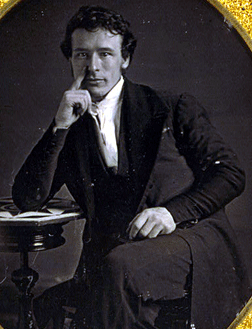
Dapper Gentleman

This fashionable Victorian showcases the high collar that was so common during the 1840's and has the low cut vest and long frock coat to complete his outfit. The sleeve on his frock coat is very tightly tailored and appears to have extra decorative buttons at the wrist. His hair is casually combed slightly forward and over his ears.

Q&A About Men's Portrait Gallery 1840

Men in the 1840s wore a more restrained and simpler silhouette influenced by Queen Victoria and Prince Albert's conservative tastes, moving away from the previous era's romantic exaggeration. Their typical ensemble included frock coats (which had replaced tailcoats for standard daytime wear), vests in vibrant colors and patterns, white shirts with narrower collars, black silk stocks or cravats, straight-cut trousers,formal top hats, and short boots, all reflecting Victorian values of piety and decorum.

Upper class men in the 1840s embraced the new, more restrained Victorian style led by Prince Albert, wearing finely tailoredfrock coats, colorful but tasteful waistcoats, pristine white shirts with modest collars, and slim trousers. For evening events, they donned the strictly codified formal attire consisting of a black tailcoat over a white shirt and white waistcoat, white stock or cravat, black pants, black leather dress shoes, and a black silk top hat.

Working-class men in the 1840s benefited from the increased availability of mass-produced clothing, particularly the new, unlined sack coat which was cheaper and easier to make. Their trousers were generally looser and made from durable fabrics in lighter colors suitable for work. The introduction of "ditto" suits—consisting of matching trousers, vest, and sack coat in black wool—provided an affordable option for Sunday best, while a variety of practical hats like wide awake hats and peaked caps completed their everyday attire.

In the 1840s, men's hairstyles changed significantly from the natural, curled looks of previous decades to a more controlled appearance. Hair was typically cut to ear length and slicked down with a side parting for a neat, orderly appearance. Facial hair became increasingly fashionable, with mustaches coming into style and a jaw-framing beard pattern growing popular in the second half of the decade, a look favored by Prince Albert himself.

Historical Emporium offers period-appropriate reproductions that capture the transition to the more restrained Victorian silhouette characteristic of 1840s men's fashion. Their well-crafted historical clothing is suitable for reenactments, theatrical productions, and collectors interested in early Victorian style when men's fashion began establishing patterns that would influence formal wear for generations. The company's attention to historical accuracy makes these garments valuable for anyone interested in this pivotal period when modern menswear began to take shape.

In the 1840s, men primarily wore four coat styles: the frock coat (which replaced the tailcoat as standard daytime dress, featuring a waist seam, knee-length skirt, and straighter silhouette); the riding coat or Newmarket (also called the "morning coat"); the tailcoat (now mainly for evening wear or formal day dress); and the newly introduced sack coat, which had no waist seam, finished at the hips, was generally unlined, and quickly became standard workingman's wear due to its ease of mass production.

The top hat remained very popular for men in the 1840s, typically made from glossy black silk rather than beaver pelt, and available in various shapes with tapered or straight crowns and wide or narrow brims. Daguerreotype photographs from the period also show men wearing a variety of other hat styles including derby hats, wide awake hats, and peaked caps, giving us insight into everyday headwear beyond formal fashion.

Men's shirts in the 1840s were almost always white and cut narrowly with set-in sleeves to be worn under the decade's slim-fitting coats. The shirt fronts could be pleated or tucked, but the romantic frills and ruffles of previous decades were no longer fashionable. Shirts typically featured detachable collars that could be washed and starched separately, with these collars being much shorter than in previous decades, reaching about two-thirds up the neck and worn either straight or with a narrow turn-down.

By the 1840s, trousers had become standard menswear, completely replacing the breeches and pantaloons of the Regency era except for riding, military, or ceremonial purposes. These trousers were slim-fitting to match the decade's overall silhouette, often worn with instep straps to maintain an elegant line, and typically constructed with a single button fly at center front (though fall-front trousers were still available for workwear). While photographs show mostly dark or black trousers, fashion plates reveal bold stripes and checks in various colors, rarely matching the coat except in the newly introduced three-piece "ditto" suits.

Vests (waistcoats) in the 1840s provided the main decorative element in a man's wardrobe, featuring vibrant colors and patterns in luxurious fabrics, including stripes, checks, and floral "sprigged" designs. They retained the shawl collar and deep V-neckline of the 1830s, though they became longer toward the end of the decade as the overall silhouette changed, with the lower hem either cut straight across or sloping to points at the center front.

In the 1840s, men most commonly wore short, pull-on boots in black leather for daytime wear, with most of the boot hidden beneath long trouser legs. These boots featured square toes and low heels, while longer boots were only worn for riding or military dress. For evening occasions, black leather slip-on dress pumps were the standard footwear, completing the formal ensemble.

Customer Reviews of our Store

Excellent Quality and Service

Sarah M.

October 15, 2025

I am absolutely thrilled with my purchase! The quality of the fabric and construction is outstanding. The attention to historical detail is impressive, and the customer service team was incredibly helpful with sizing questions.

Perfect for My Event

Rebecca L.

September 28, 2025

I ordered this outfit for a historical reenactment, and it exceeded all my expectations. The fit was perfect, and I received so many compliments. Will definitely be ordering from Historical Emporium again!

Authentic and Beautiful

Jennifer K.

September 10, 2025

The attention to detail in these garments is remarkable. The fabrics are high quality, and the construction is solid. I appreciate that they offer authentic historical clothing that actually fits modern women.

Great Customer Support

Emily R.

August 22, 2025

Had a question about my order and the customer service team responded quickly and professionally. The product arrived on time and was exactly as described. Highly recommend this company!