Men's Portrait Gallery 1890

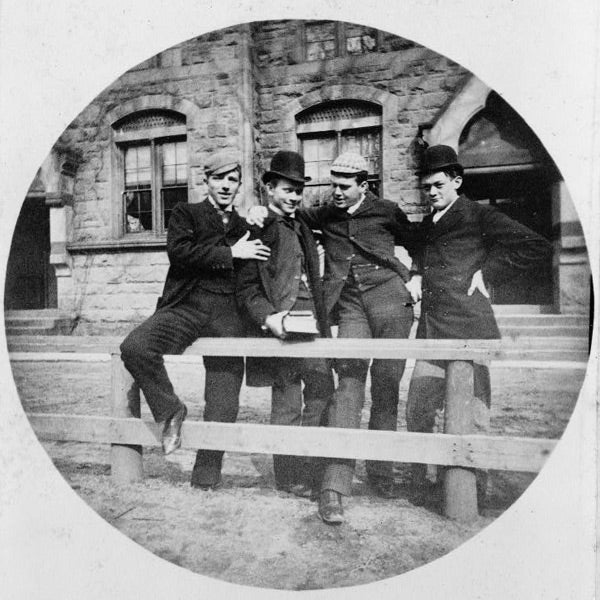
College Chums

Clearly good friends, this flamboyant quartet from Yale display the popular fashion of the day. Note the news caps on two of the gentlemen and the high top Derby on the others. All display a high button sack coats with the coat left open to display their waistcoats.

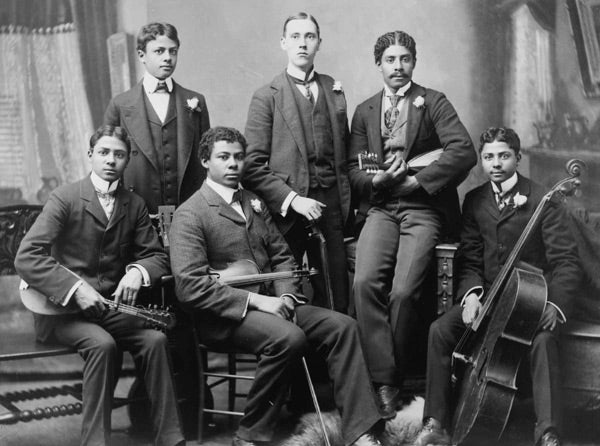
Musical Ensemble

This well tuned ensemble of players look ready for the stage in their finely pressed wool suits. Notice the tight tailoring in the arms and the narrow lapels. The only true note of individuality comes in their choice of shirt collar and neckties. You see not only the popular high stand collar and wing tip collars that have been around for decades, but also the rounded banker collar.

Most wear the four-in-hand tie or "teck tie" which by the mid 90’s was among the most popular choice for neckwear. The gentleman standing at the back left and his friend seated in the front row sport a small bow tie that has the ends tucked in to show only the knot.

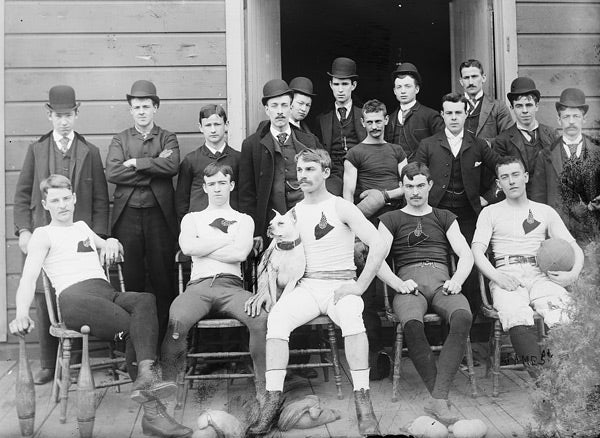
Sportsmen

These strapping young men are photographed with sporting equipment of the era and you can see a wide range of clothing. From daily dress wear to the proper athletic attire of the gentlemen in the front row. Note the ubiquitous derby and four-in-hand ties. The third gentleman from the left shows the popular narrow lapel on his jacket and is fully buttoned so that only a small bit of his tie is visible. Others display the more loosely tied Full Windsor knot.

Q&A About Men's Portrait Gallery 1890
Men in the 1890s wore clothing characterized by high necklines and very trim fits. Their standard attire included shorter-length coats (typically buttoned only at the top to display the vest and watch chain), high-collared shirts, neckwear such as small bow ties or four-in-hand ties, closely-fitted trousers, and tall derby hats. The three-piece black wool sack suit became standard for office workers, while morning coats (cutaways) were common for formal daywear and business attire, with tailcoats reserved for evening formal occasions.

The men's fashion style of the 1890s was characterized by a long, narrow silhouette with high necklines and trim fits. Key elements included shorter coats worn open except for the top button to display vests and watch chains, extremely tall shirt collars (up to 3 inches), closely-fitted trousers, and tall crowned hats like the derby. Mass production had standardized clothing, with the three-piece sack suit becoming universal business attire. The decade also saw specialized sportswear for different leisure activities and the growing acceptance of the tuxedo (dinner jacket) as an alternative to the traditional tailcoat for evening wear.

Upper class men in the 1890s wore impeccably tailored clothing of the finest materials, maintaining multiple outfits for different occasions throughout the day. Their wardrobe typically included formal morning (cutaway) coats for daytime events, Prince Albert double-breasted frock coats for the most formal day occasions, and immaculate tailcoats with silk facings for evening functions. They could afford luxurious smoking jackets for at-home leisure, made with quality fabrics and detailed trim work. Their accessories included gold pocket watches, silk top hats for formal occasions, premium quality derbies or Homburgs for daily wear, and fine leather footwear. While they followed the same silhouette as middle-class men, the superior quality, perfect fit, and appropriate variety of their garments clearly signaled their social position.

Lower class men in the 1890s benefited from the mass production of clothing but still dressed more simply than their middle and upper-class counterparts. Working-class men typically owned fewer garments, often just one suit for Sunday church and special occasions, and practical workwear for their daily labor. Their shirts were frequently made of durable chambray in white, light blue, or striped patterns, sometimes worn without the rigid detachable collars or with softer turn-down collars. Many laborers wore denim work pants, sturdy cotton or wool trousers, and simple vests without matching jackets. For headwear, cloth caps were more common than the derbies worn by the middle class. While mass production made fashion more accessible, quality, variety, and the ability to follow changing styles still marked clear class distinctions.

The 1890s represent the final decade of Victorian era fashion, sometimes called the "Late Victorian" or "Mauve Decade" period. This decade marks an important transition point between the formal Victorian styles and the more relaxed Edwardian fashion that would follow after Queen Victoria's death in 1901. It was characterized by standardization through mass production, the rise of ready-to-wear clothing, and the beginning of modern consumerism facilitated by mail-order catalogs. The 1890s also saw greater specialization in men's clothing, with different garments designed for various sports and leisure activities, reflecting the growing middle class's interest in recreation. Fashion innovations of this decade, particularly the rising popularity of the tuxedo, would significantly influence men's formal wear throughout the 20th century.

Historical Emporium offers well-crafted reproductions of 1890s men's clothing that balance historical accuracy with modern wearability. Their garments feature period-appropriate styles, cuts, and details while incorporating contemporary construction techniques for comfort and durability. The company provides a full line of men's period clothing suitable for movie and TV production, theatrical performances, living history events, and vintage-themed weddings, with individual pieces available to create authentic 1890s ensembles.

d details while incorporating contemporary construction techniques for comfort and durability. The company provides a full line of men's period clothing suitable for movie and TV production, theatrical performances, living history events, and vintage-themed weddings, with individual pieces available to create authentic 1890s ensembles.

Men in the 1890s wore several types of coats: the morning coat (or cutaway) with its waist seam and sloping front was replacing the frock coat for formal daywear and business attire; the sack coat continued rising in popularity for everyday wear and became the standard for office workers as part of three-piece suits; specialized sporting coats like the Norfolk jacket, Reefer jacket, and blazers were used for hunting, golf, tennis, and rowing; and overcoats such as the knee-length Chesterfield, the longer Ulster (often with a cape), and the single-breasted Covert topcoat provided protection in inclement weather.

Men's trousers in the 1890s were closely fitted, though they became slightly looser as the decade progressed. They were typically made in muted colors like grays, browns, tans, dark blues, and blacks, and were held up by suspenders rather than belts. While trousers often matched the jacket and vest in three-piece suits, striped trousers or lighter-colored trousers paired with darker vests and jackets were also common. For sporting activities and bicycling, loose knee breeches (knickers) gained popularity, offering greater freedom of movement when paired with Norfolk or sack jackets and gaiters.

Men's shirts in the 1890s became narrower in the body and sleeve to accommodate the trim-cut vest and coat. The most distinctive feature was the extremely tall collars, some reaching 3 inches in height, which could be straight or ironed to a small wingtip style. Full turn-down collars were reserved for more casual outfits. White shirts remained most popular, though striped and printed options were available. Detachable collars and cuffs were standard, allowing for economical laundering. As the decade progressed, turtleneck sweaters began appearing, particularly for sporting activities, sometimes even worn under suit jackets.

Men in the 1890s wore a variety of hats, with the tall-crowned derby (bowler) being the most popular for everyday wear, perfectly complementing the era's long, narrow silhouette. The Homburg, with its central crease and turned-up brim, was favored by businessmen and even the Prince of Wales. The soft Fedora with its indented crown was emerging in popularity and would eventually become the defining headwear of the early 20th century. For summer, straw boater hats were common, while the silk top hat remained essential for formal occasions. In western regions, the wide-brimmed wide-awake hat provided practical sun protection.

Men's neckwear in the 1890s was available in various styles but was generally smaller than in previous decades. Small bow ties, four-in-hand ties, and ascots were all equally acceptable for work or leisure activities. These narrower ties complemented the decade's emphasis on trim fits and high collars, with the choice of style often depending on the occasion and personal preference rather than strict fashion rules. White or black bow ties were standard for formal evening wear, while colorful options might be seen in more casual settings.

For formal evening occasions in the 1890s, men primarily wore black tailcoats with silk roll or notched collars, paired with matching trousers often featuring braided side seams. A low-scooped waistcoat in white, black, or subtle patterns was worn over a white tall-collared shirt with a plain starched front or dickey. A white or black bow tie (depending on the formality of the event) completed the ensemble, topped with a silk hat. As the decade progressed, the tuxedo (dinner jacket) became increasingly acceptable as an alternative to the tailcoat. For outerwear, the Inverness cape—a long, single-breasted, sleeveless coat with a cape—provided warmth and style when worn over formal attire.

Working men in the 1890s did wear denim jeans, though they were considered strictly workwear rather than fashion items. Following their introduction by Levi Strauss and Jacob Davis in 1873 with their patented copper riveting system, denim work pants had become increasingly popular among laborers, miners, cowboys, and farmers for their exceptional durability. However, these early jeans were quite different from modern styles—they featured a higher waist, button fly, suspender buttons, and straight legs. They were utilitarian garments designed for hard physical labor and would never have been worn in social or business settings by men of any class.

For sports and leisure in the 1890s, men wore specialized garments suited to different activities. The Norfolk jacket with its belted waist and pleated design was popular for hunting and golf, while blazers were preferred for rowing and tennis. Loose knee breeches (knickers) paired with long stockings replaced full-length trousers for bicycling, golf, and other active pursuits. As basketball was invented in 1891, early players wore simple athletic attire including loose shirts and shorts. Turtleneck sweaters began appearing for sporting activities and could even be worn under suit jackets. This specialization of sportswear reflected the growing middle class's interest in leisure activities and their ability to afford activity-specific clothing.

Men's fashion from the 1880s to the 1890s evolved through several subtle but significant changes: coat necklines became even higher while the garments were cut shorter in length; shirt collars grew to extreme heights of up to 3 inches; trousers remained fitted but became slightly looser toward the end of the decade; the three-piece sack suit became firmly established as standard business attire; the morning coat (cutaway) increasingly replaced the frock coat for formal daywear; specialized sportswear expanded with the growing popularity of leisure activities; and the tuxedo (dinner jacket) gained greater acceptance as an alternative to the tailcoat for evening wear, setting the stage for significant fashion changes in the coming century.

Mass production had a profound impact on 1890s men's fashion, making standardized clothing accessible to most social classes. With improved manufacturing techniques, expanded railroad networks, and the introduction of rural mail delivery, catalog companies like Sears and Roebuck could offer a wide range of affordable ready-made garments even to remote areas. By the 1890s, the average working man's entire wardrobe consisted of mass-produced clothing, from suits to overcoats to underwear. This democratization of fashion led to greater uniformity in men's attire, with the three-piece black wool sack suit becoming the standard for office workers everywhere, while still maintaining clear quality distinctions between social classes.

Customer Reviews of our Store

Excellent Quality and Service

Sarah M.

October 15, 2025

I am absolutely thrilled with my purchase! The quality of the fabric and construction is outstanding. The attention to historical detail is impressive, and the customer service team was incredibly helpful with sizing questions.

Perfect for My Event

Rebecca L.

September 28, 2025

I ordered this outfit for a historical reenactment, and it exceeded all my expectations. The fit was perfect, and I received so many compliments. Will definitely be ordering from Historical Emporium again!

Authentic and Beautiful

Jennifer K.

September 10, 2025

The attention to detail in these garments is remarkable. The fabrics are high quality, and the construction is solid. I appreciate that they offer authentic historical clothing that actually fits modern women.

Great Customer Support

Emily R.

August 22, 2025

Had a question about my order and the customer service team responded quickly and professionally. The product arrived on time and was exactly as described. Highly recommend this company!